
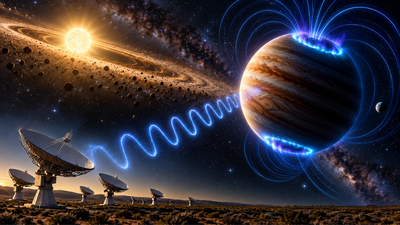
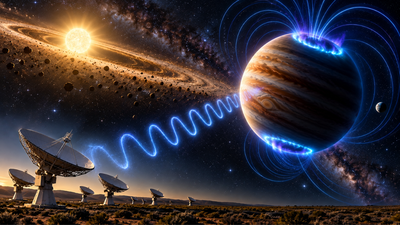
Astronomers have reported the first direct detection of radio emission from an exoplanet, tracing the signals to the young gas giant β Pictoris b, located approximately 64 light-years from Earth. Using South Africa’s MeerKAT radio telescope, researchers identified recurring radio bursts and localised their source to the planet rather than its host star. The emission is believed to be linked to auroral activity generated by the planet’s magnetic field. The observations also helped scientists estimate the magnetic field strength in the region producing the radio waves. The discovery offers a new method for studying magnetic fields beyond the Solar System and could provide insights into the internal processes of young, massive gas giants.
Astronomers trace radio signals to a distant exoplanet
A research team led by Kevin Ortiz Ceballos at the Center for Astrophysics Harvard & Smithsonian observed the β Pictoris planetary system during four observing sessions across two frequency bands. They detected faint, repeating radio bursts but initially could not determine whether the signals originated from the host star or one of its planets. To identify the source, the researchers compared their radio images with the precise positions of distant quasars, which served as fixed reference points. The resulting analysis showed that the radio emission aligned with β Pictoris b, supporting its identification as the source.Two of the radio bursts occurred approximately eight hours apart. This interval is close to the planet’s estimated rotation period of around eight to nine hours, providing additional evidence that the emission could be connected to its rotating magnetosphere.
Auroras may be producing the radio signals
The researchers linked the emission to auroral activity associated with β Pictoris b’s magnetic field. Auroras occur when energetic charged particles move along magnetic field lines and interact with a planet’s upper atmosphere. On Earth, this process produces the northern and southern lights. At β Pictoris b, the team believes that energetic electrons moving through the magnetic field generate radio waves through a process called electron cyclotron maser emission. This mechanism is also associated with radio emissions detected from planets in our Solar System.
Radio frequencies reveal the magnetic field
The frequency of electron cyclotron maser emission is related to the magnetic field strength in the region where the radiation originates. Based on the observed radio signals, the researchers estimated that the magnetic field at the emission site is at least 1,250 gauss, or 1.25 kilogauss. This is considerably stronger than Jupiter’s overall magnetic field. The estimate applies to the area producing the radio waves and does not represent a direct measurement of the magnetic field across the entire planet.
Discovery offers clues about young gas giants
β Pictoris b is a young, massive gas giant, making it a valuable target for studying how planetary magnetic fields develop. These fields are generated by processes inside planets and influence their interactions with charged particles and stellar winds. The researchers said their findings are consistent with theoretical predictions for the magnetic fields of young giant planets. Studying the planet’s radio emission could help scientists test these models and learn more about its internal structure.
A new method for studying distant planets
Radio observations can provide information that is difficult to obtain through conventional imaging. By examining the frequency, polarisation and location of radio emission, astronomers can investigate magnetic conditions around distant planets. The localisation of the signals to β Pictoris b offers a way to distinguish planetary emission from radio activity produced by the host star. Future observations could determine whether similar auroral radio signals occur around other exoplanets.
Findings follow earlier radio searches
Astronomers have previously searched for radio emission from exoplanetary systems, but identifying the precise source has remained a challenge. Signals detected from a planetary system may originate from the host star instead of a planet. Earlier observations of β Pictoris b, including a 2024 search using the upgraded Giant Metrewave Radio Telescope, did not report a detection from the planet. The latest research uses positional measurements to associate the radio emission with β Pictoris b.The research paper was posted on the arXiv preprint server on September 15, 2026, and has not yet undergone formal peer review. The findings represent the research team’s reported results and could be examined further through independent observations. Additional data may help confirm the radio source, clarify the relationship between the bursts and the planet’s rotation, and refine the estimate of its magnetic field.